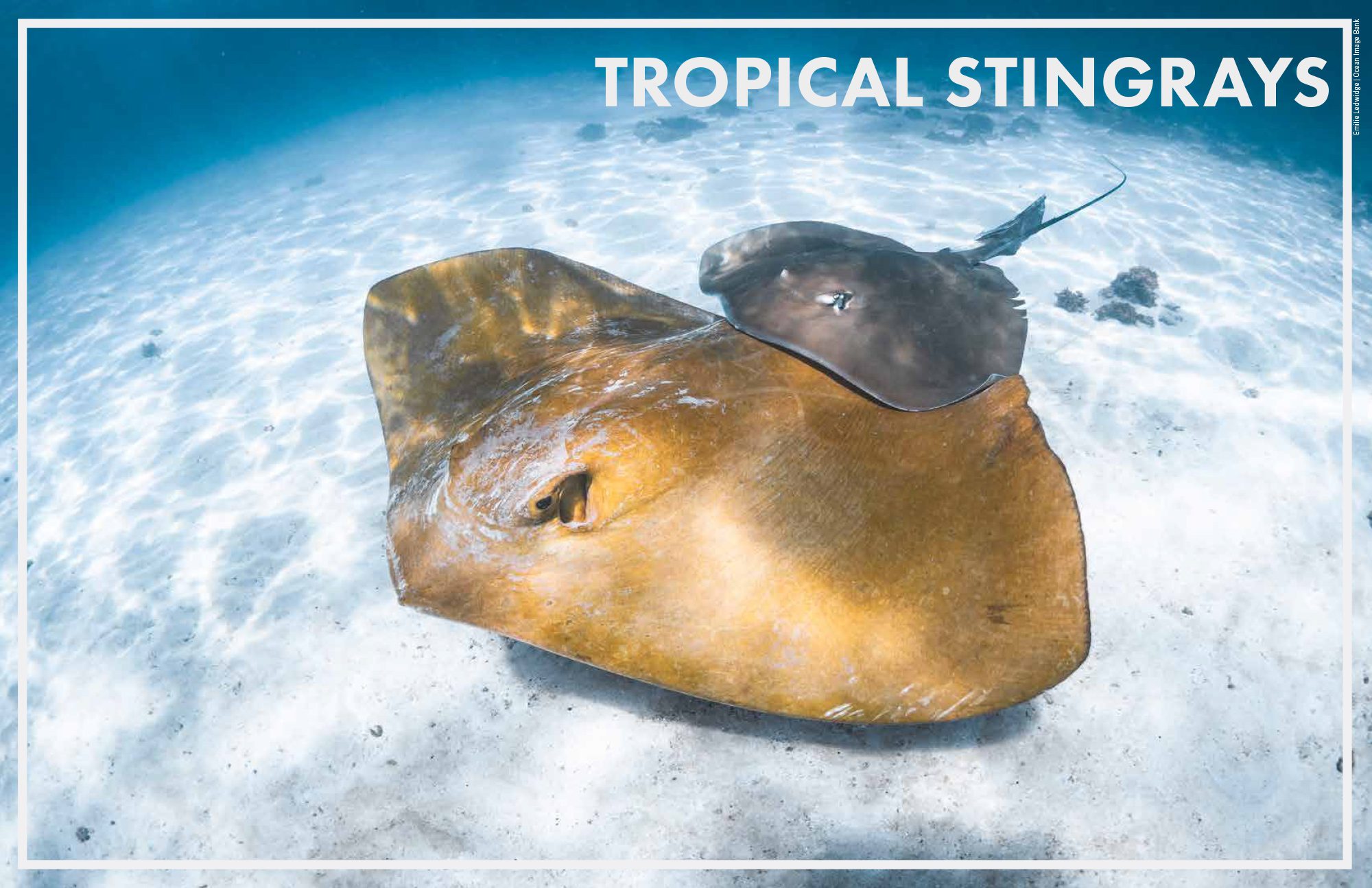
Tropical stingrays include benthic stingrays (Batoidea: Myliobatiformes) that spend most of their life in tropical and subtropical marine environments. They have round or rhomboidal disc-shaped bodies, are dorso-ventrally compressed with ventrally located mouths and gills, and have large openings by their eyes known as spiracles; all traits that facilitate life on the seafloor (Aschliman et al., 2012). Tropical stingrays exhibit undulatory swimming that does not require tail propulsion, yet their tails can be longer than the width of their disc, with one or more caudal barbs or ‘stings’ (Last et al., 2016). All stingrays are viviparous with litters of one to ten pups and gestation periods of three to 12 months (Last et al., 2016). Tropical stingrays encompass 110 known species across three families (Last et al., 2016; Stein et al., 2018), including 91 Dasyatidae species (all except one freshwater and one pelagic species – Chindwin Cowtail Ray [Makararaja chindwinensis] and Pelagic Stingray [Pteroplatytrygon violacea], respectively), 17 species in two genera in the family Urotrygonidae, and two species in the genus Styracura (family Potamotrygonidae; Table 1).