
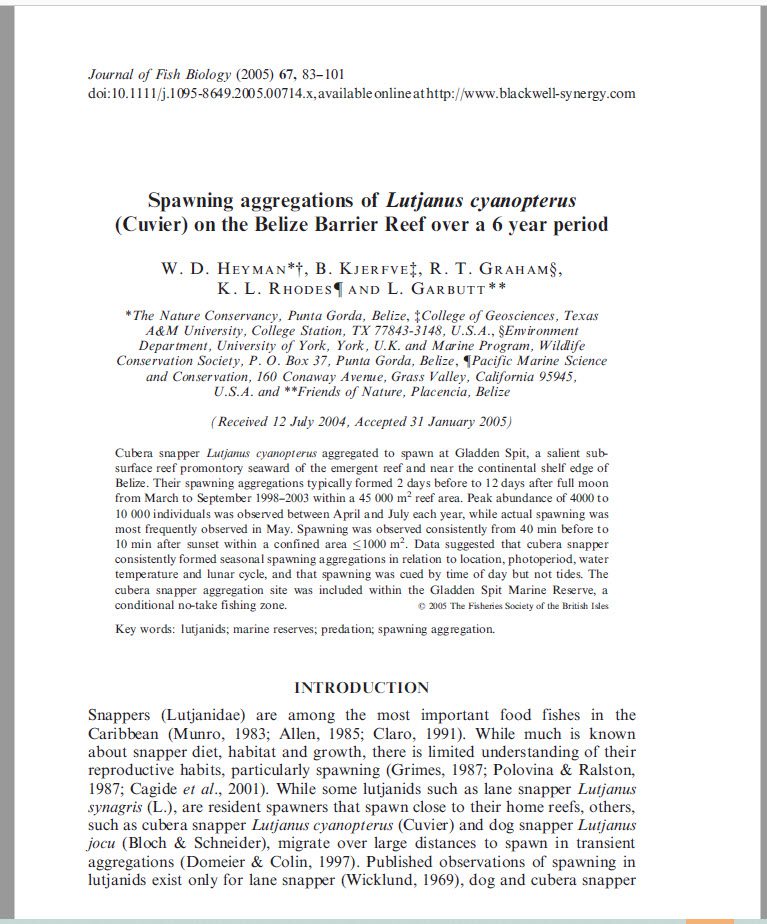
Spawning aggregations of Lutjanus cyanopterus (Cuvier) on the Belize Barrier Reef over a 6 year period

Snappers (Lutjanidae) are among the most important food fishes in the Caribbean (Munro, 1983; Allen, 1985; Claro, 1991). While much is known about snapper diet, habitat and growth, there is limited understanding of their reproductive habits, particularly spawning (Grimes, 1987; Polovina & Ralston, 1987; Cagide et al., 2001). While some lutjanids such as lane snapper Lutjanus synagris (L.), are resident spawners that spawn close to their home reefs, others, such as cubera snapper Lutjanus cyanopterus (Cuvier) and dog snapper Lutjanus jocu (Bloch & Schneider), migrate over large distances to spawn in transient aggregations (Domeier & Colin, 1997). Published observations of spawning in lutjanids exist only for lane snapper (Wicklund, 1969), dog and cubera snapper…


W. D. HEYMAN, B. KJERFV, R. T. GRAHAM, K. L. RHODES AND L. GARBUTT
Related Resources

Satellite tracking of tiger sharks in the Eastern Central Atlantic reveals varied space-use patterns and ocean-basin connectivity
Large-bodied sharks, including the tiger shark (Galeocerdo cuvier), play crucial roles as top predators in marine ecosystems, regulating...
READ MORE
Characterizing seasonal whale shark habitat in the western North Atlantic
There are significant knowledge gaps in the ecology of whale sharks Rhincodon typus beyond well-studied coastal aggregation sites....
READ MORE
Validation and otolith‐mass prediction of age and growth for cardinal snapper Pristipomoides macrophthalmus of the Caribbean Sea
Abstract Cardinal snapper Pristipomoides mac- rophthalmus is a commercially important, but com- monly misidentifed, deepwater species...
READ MORE
1 2 3 19